

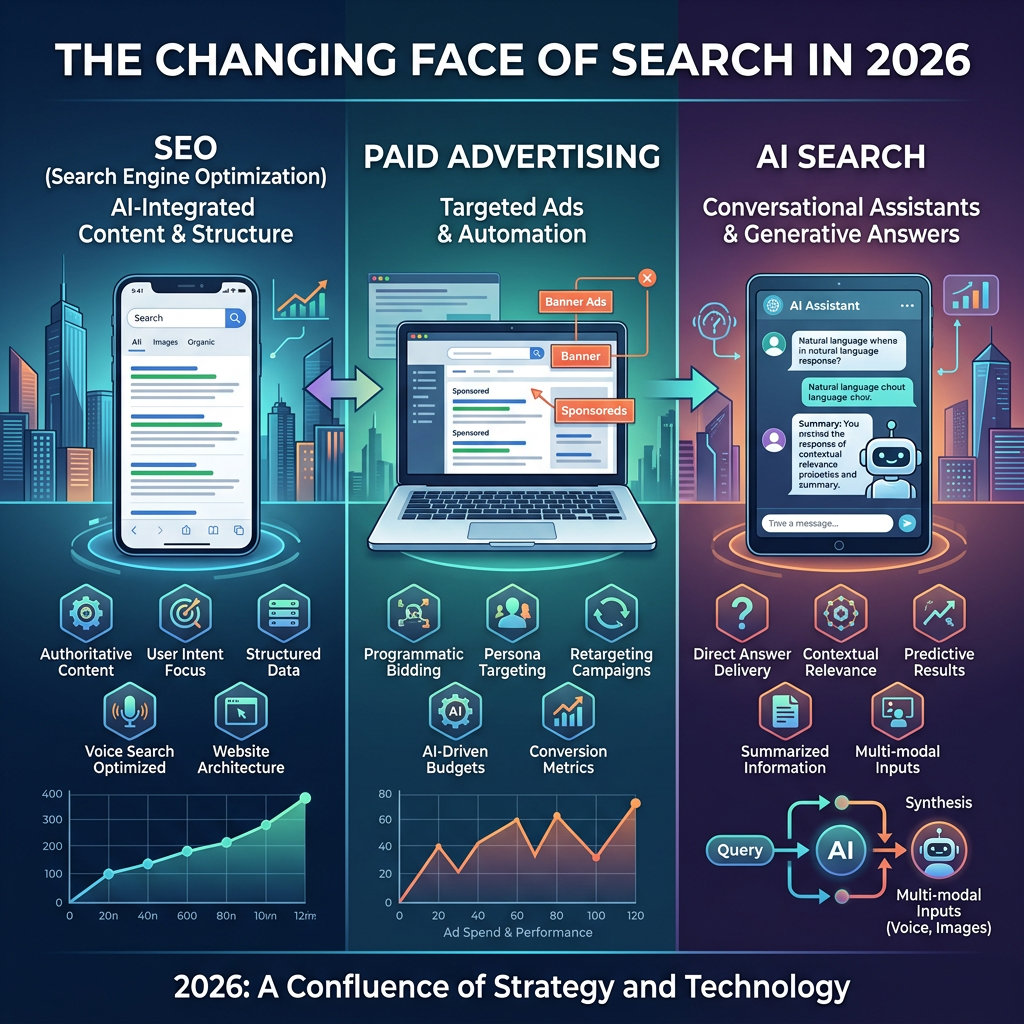
The Changing Face of Search in 2026: SEO, Paid Advertising, and AI Search
What business owners need to know—and what they should expect from their website developer
October 2026 | Chesley Software
For years, getting your business found online meant one thing above all else: showing up in Google search results. Businesses invested in Search Engine Optimization (SEO), sometimes supplemented by paid advertising, to attract potential customers to their websites.
That approach is undergoing its biggest transformation in decades.
Today, someone looking for a product, service, or professional might still use traditional Google search. But they might also ask ChatGPT for recommendations, consult Google’s AI-generated answers, or use Microsoft’s Copilot to research their options.
The distinction matters because these different approaches don’t necessarily produce the same results—or send visitors to your website in the same way.
For small businesses, the challenge isn’t to abandon traditional SEO. It’s to understand how organic search, paid advertising, and AI-powered discovery now work together, and to make sure your website is prepared.
1. Traditional Organic Search: Still the Foundation
Organic search refers to the unpaid results that appear when someone searches Google, Bing, or another search engine.
For example, someone might search for:
- “WordPress website developer in New Hampshire”
- “Best local landscaping companies”
- “Professional hypnosis training courses”
Search engines evaluate websites and attempt to return the most relevant, useful, and trustworthy results.
SEO involves making your website easier for search engines to discover, understand, and recommend.
What good SEO looks like in 2026
The fundamentals remain surprisingly consistent:
- Quality content: Pages that clearly explain your services, answer customer questions, and demonstrate genuine expertise.
- Technical health: A website that loads quickly, works properly on mobile devices, uses HTTPS, and can be indexed by search engines.
- Clear organization: Logical navigation, descriptive page titles, meaningful headings, and appropriate internal links.
- Local visibility: Accurate business information, a properly maintained Google Business Profile, and consistent contact details.
- Credibility: Authentic customer reviews, professional credentials, relevant references, and links from reputable websites.
Search engines have become increasingly sophisticated at evaluating content. Simply repeating keywords or creating large numbers of generic blog posts is no longer a sound strategy.
The objective is to create the best possible resource for the customers you’re trying to reach—not merely to satisfy a search algorithm.
2. Paid Search: Paying for Visibility
Paid search advertising, often called Pay-Per-Click (PPC), allows businesses to purchase advertising placements in search results.
Google Ads and Microsoft Advertising are two major platforms.
Unlike organic search, where visibility is earned through relevance and credibility, paid advertising allows businesses to compete for exposure to people searching for particular products or services.
For example, a local contractor might advertise to people searching for “deck construction near me.”
Advantages of paid search
Paid advertising can deliver visibility relatively quickly, especially for a new website that hasn’t yet established strong organic rankings.
It also provides targeting options based on factors such as geographic location, search intent, and audience characteristics.
Campaigns can be measured through clicks, inquiries, purchases, and other conversions.
The limitations
Paid search requires an ongoing advertising budget. When the advertising stops, the associated paid visibility generally stops too.
Competition can make desirable search terms expensive, and poorly configured campaigns can consume a budget without generating worthwhile business.
Importantly, advertising platforms are increasingly using AI to automate targeting, ad creation, and campaign optimization.
That automation can be helpful, but it doesn’t eliminate the need for oversight. Businesses still need to understand what they’re spending and whether the resulting leads or sales justify the expense.
Our perspective: Paid search is often best viewed as a complement to a strong website and organic search strategy, rather than a replacement for either.
3. AI Search: The Biggest Change in How People Find Information
Artificial intelligence is fundamentally changing the search experience.
Traditional search typically presents a list of websites for the user to investigate.
AI-powered search often goes a step further: it attempts to answer the question directly, combining information from multiple sources and sometimes recommending specific businesses, products, or services.
Consider the difference.
Traditional search:
“Best WordPress hosting for small business”
The user receives a list of websites, reviews, advertisements, and articles to explore.
AI search:
“I’m running a small business website on WordPress. I want reliable managed hosting, automatic backups, strong security, and good support. What are my best options?”
An AI assistant may compare hosting providers, explain the tradeoffs, recommend several options, and provide links to supporting sources—all within a single conversation.
The user may make substantial progress toward a decision without visiting many websites.
Why this matters to your business
In July 2025, Pew Research Center reported that Google users clicked a traditional search result in just 8% of visits when an AI summary appeared, compared with 15% when no AI summary appeared.
That study doesn’t mean all businesses should expect their traffic to fall by half. It does, however, demonstrate an important shift: being visible in search and receiving a website visit are no longer the same thing.
AI systems may introduce customers to your business without immediately sending them to your website.
That creates both a challenge and an opportunity.
Businesses increasingly need to think about whether AI systems can accurately understand and recommend their services—not simply whether they rank for a particular keyword.
4. A New Term: Generative Engine Optimization (GEO)
You may be hearing terms such as Generative Engine Optimization (GEO), Answer Engine Optimization (AEO), and AI Search Optimization.
These generally describe efforts to make a business and its content more discoverable and useful to AI-powered search systems.
Although the terminology is new, much of the underlying work overlaps with traditional SEO.
AI systems benefit from websites that clearly explain:
- What the business does and whom it serves.
- What makes its products or services different.
- Where it operates and how customers can contact it.
- What qualifications, experience, or evidence support its claims.
- Answers to the specific questions prospective customers are likely to ask.
Original content can be especially valuable. Case studies, detailed service explanations, examples of completed projects, frequently asked questions, and well-supported educational articles provide information that generic marketing copy often lacks.
Structured data, sometimes called schema markup, can also help search engines interpret certain information about your business and website.
However, there is an important distinction between good optimization and unrealistic promises.
No website developer or marketing agency can guarantee that ChatGPT, Google AI, or another AI service will recommend your business.
AI systems use different sources and methods, and their answers may vary between users, questions, and even repeated searches.
In fact, Google’s own guidance emphasizes that the fundamentals of good SEO remain relevant to its AI search features. There is no special technical shortcut that guarantees inclusion.
5. Organic Search vs. Paid Search vs. AI Search
These are not three entirely separate worlds. They overlap, and a business may benefit from all three.
| Approach | Primary benefit | Main consideration |
|---|---|---|
| Organic SEO | Builds long-term visibility and credibility | Requires ongoing effort and patience |
| Paid search | Provides targeted exposure and faster testing | Requires advertising spend and active management |
| AI search optimization | Helps businesses become discoverable in AI-generated answers and recommendations | Visibility is less predictable and harder to measure |
It’s also worth recognizing that AI search is not necessarily free of advertising. Google and Microsoft are integrating AI into their advertising products and search experiences.
The boundaries between these approaches will likely become less distinct over time.
For most small businesses, the most practical approach is to build a strong organic foundation, evaluate paid advertising where appropriate, and ensure their content is ready for AI-driven discovery.
6. What Should You Expect From Your Website Developer?
This is an especially important question because website development, search optimization, and digital marketing are related—but they are not identical services.
A well-built website should provide the technical foundation for search visibility.
That does not mean every website development project automatically includes an ongoing SEO campaign, advertising management, or content marketing.
Here is how we think about those responsibilities.
Essential: What a professional website developer should provide
A properly developed business website should generally include:
- Responsive design that works well on phones, tablets, and desktop computers.
- Secure HTTPS connections and appropriate website security measures.
- Reasonable page-loading performance.
- Logical navigation and accessible page structure.
- Proper page titles, headings, and descriptive URLs.
- Search-engine-friendly technical configuration.
- XML sitemaps and appropriate indexing controls.
- Proper redirects when existing pages are moved or replaced.
- Integration with analytics and search monitoring tools when included in the project scope.
For WordPress websites, this also means choosing appropriate themes and plugins, avoiding unnecessary complexity, and keeping the underlying platform properly maintained.
These are foundational development practices—not advanced marketing techniques.
Recommended: Search visibility and measurement
Beyond the technical foundation, businesses should consider:
- Configuring Google Search Console and Bing Webmaster Tools.
- Setting up Google Analytics or another appropriate analytics solution.
- Defining important website conversions, such as contact form submissions, bookings, or purchases.
- Reviewing the site’s main service pages for clear, useful content.
- Implementing relevant structured data.
- Optimizing images and important media.
- Ensuring local business information is consistent and accurate.
These services may be included in a website project or provided separately, depending on the developer’s scope of work.
Ongoing: Marketing and optimization services
Activities such as keyword research, competitive analysis, content strategy, regular blog publishing, backlink outreach, paid advertising management, and conversion optimization are generally ongoing marketing services.
They require continued investment and measurement.
AI search introduces additional opportunities to review how a business appears in AI-generated responses, improve the clarity of its content, and identify gaps in how its expertise is represented online.
Businesses should expect their developer or marketing partner to explain which services are included, what outcomes can reasonably be measured, and which activities require additional investment.
7. How Do You Measure Success When Search Is Changing?
Historically, many businesses focused on their Google rankings and the number of visitors arriving from organic search.
Those measurements still matter, but they no longer tell the whole story.
In 2026, businesses should pay increasing attention to:
Qualified inquiries and conversions. Are the people finding your business contacting you, scheduling appointments, or purchasing your services?
Organic search performance. Which pages and search queries are generating visibility and traffic?
AI search visibility. Does your business appear in relevant AI-generated answers? Is the information accurate, and are users being directed to appropriate pages?
Referral traffic. Are visitors arriving from AI assistants or other emerging discovery platforms?
Cost per acquisition. If you’re advertising, how much does it cost to generate a qualified lead or customer?
AI visibility measurement is still evolving. Google has expanded Search Console reporting for generative AI features, while referral traffic from standalone AI assistants can sometimes be identified in analytics.
Neither approach provides a complete picture of every AI recommendation or brand mention.
For that reason, businesses should be cautious about vendors promising precise AI rankings or guaranteed placement.
Ultimately, the most important measurement remains whether your online presence is helping your business achieve its goals.
8. Five Practical Steps Business Owners Can Take Now
You don’t need to rebuild your website simply because AI search has arrived.
For many businesses, a focused review of the existing website is a better starting point.
1. Review your most important pages. Make sure visitors—and search systems—can quickly understand what you offer, whom you serve, and why someone should choose you.
2. Answer real customer questions. Build useful content around questions customers actually ask. A thoughtful FAQ, service guide, or case study may be more valuable than a dozen generic blog posts.
3. Verify your business information. Keep your contact information, business profiles, services, and operating details accurate and consistent.
4. Confirm that measurement is working. Ask your developer whether your website is connected to the appropriate search and analytics tools, and whether important customer actions are being tracked.
5. Discuss AI readiness with your developer. Ask whether your website is technically accessible to search systems, whether its content clearly communicates your expertise, and what practical improvements would provide the greatest value.
The goal isn’t to chase every new search trend. It’s to ensure that your website continues to serve customers effectively as the tools they use evolve.
9. Our Perspective at Chesley Software
At Chesley Software, we believe a business website should be more than an attractive collection of pages.
It should be a reliable, well-structured, maintainable business asset that helps prospective customers understand your services and take the next step.
The emergence of AI search reinforces something we’ve believed for years: sound website architecture, useful content, good performance, and clear communication are more valuable than shortcuts designed to manipulate search rankings.
The technology will continue to evolve. Some search traffic may shift away from traditional results. New advertising opportunities will emerge, and the methods used to measure online visibility will become more sophisticated.
But the fundamental objective remains the same.
Help the right people discover your business, establish their confidence, and make it easy for them to become customers.
That’s the foundation of an effective website—regardless of whether someone finds you through Google, a paid advertisement, or an AI assistant.
Is Your Website Ready for the Next Generation of Search?
If you’re unsure whether your WordPress website is properly configured for today’s search environment, Chesley Software can help you evaluate its technical foundation, search visibility, and opportunities for improvement.
Visit ChesleySoftware.com to start the conversation.

